

STRUCTURED MATURITY ASSESSMENT
Two weeks.
One domain.
A decision-ready answer.
The Structured Maturity Assessment: a focused entry point for companies facing CX, CRM, or omnichannel decisions.
2 weeks · your choice of 6 domains · 1 decision-ready readout
WHAT IT IS
The Structured Maturity Assessment is a focused, two-week engagement for companies facing important CX, CRM, or omnichannel decisions, or whose ongoing initiatives are not delivering the expected impact. It assesses one clearly defined domain, evaluates risks, constraints, and potential, and translates them into prioritized action areas and a realistic next step.
The assessment examines the relevant structures, processes, data, systems, governance, and ways of working. Existing documentation, targeted interviews, and a structured maturity framework establish the current state, identify the constraints that matter most, and distinguish symptoms from underlying causes.
The scope is deliberately narrow. Focusing on one domain keeps the analysis evidence-based, the client effort manageable, and the result usable within two weeks. The outcome is not a generic maturity score, but a clear view of what requires attention, what can wait, and which decision is justified next.
After two weeks, leadership knows where the selected domain stands, what is holding it back, which actions matter most, and whether the next investment should proceed, change direction, or wait.
A precise basis for the next investment decision.
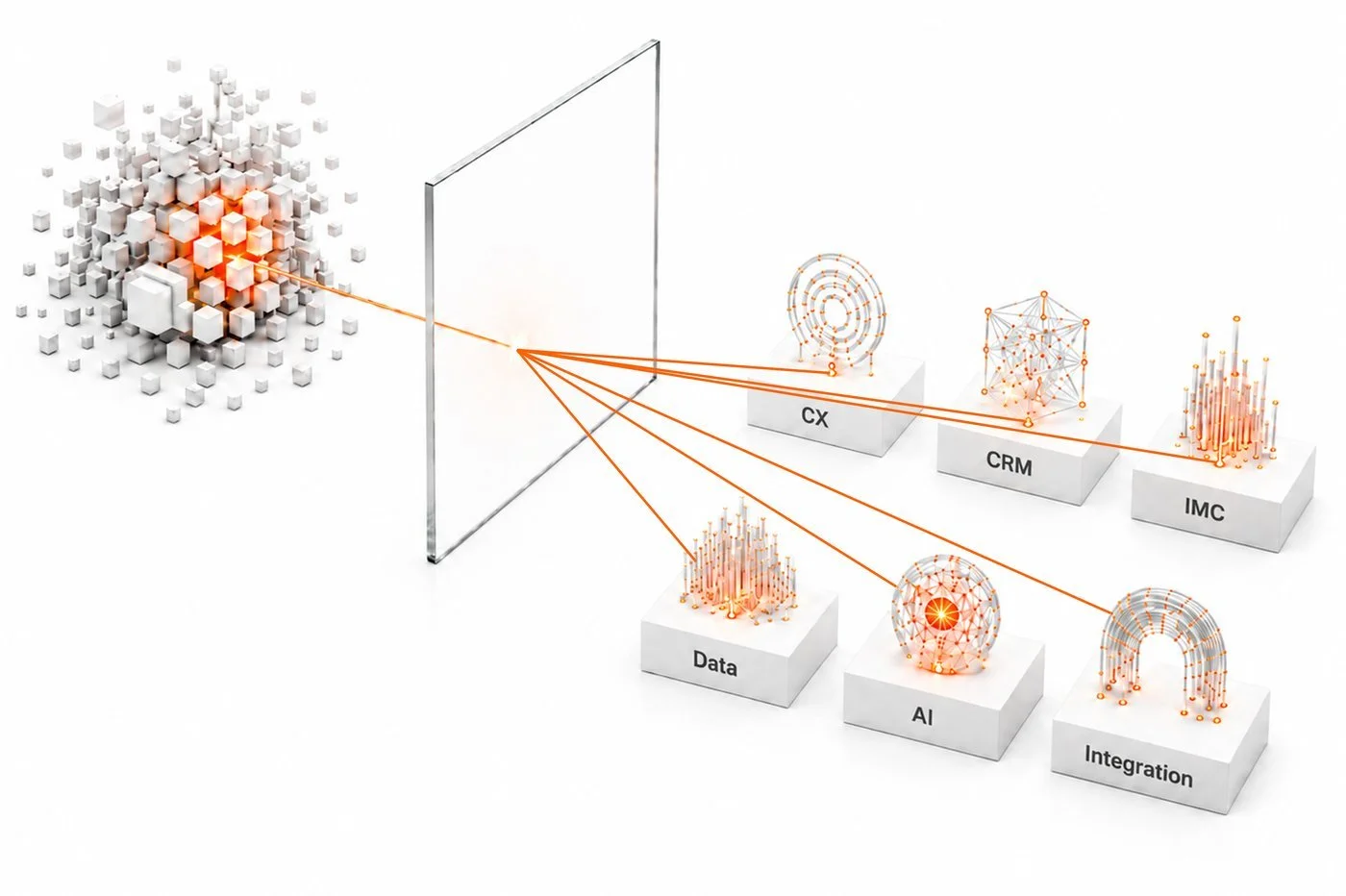
The Structured Maturity Assessment is a focused, two-week engagement for companies facing important CX, CRM, or omnichannel decisions, or whose ongoing initiatives are not delivering the expected impact. It assesses one clearly defined domain, evaluates risks, constraints, and potential, and translates them into prioritized action areas and a realistic next step.
The assessment examines the relevant structures, processes, data, systems, governance, and ways of working. Existing documentation, targeted interviews, and a structured maturity framework establish the current state, identify the constraints that matter most, and distinguish symptoms from underlying causes.
The scope is deliberately narrow. Focusing on one domain keeps the analysis evidence-based, the client effort manageable, and the result usable within two weeks. The outcome is not a generic maturity score, but a clear view of what requires attention, what can wait, and which decision is justified next.
After two weeks, leadership knows where the selected domain stands, what is holding it back, which actions matter most, and whether the next investment should proceed, change direction, or wait.
SIX DOMAINS
Each assessment focuses on the domain where clarity and prioritization are needed most.
Scope and focus are defined at the outset, keeping the analysis precise and directed at the area where the next decision matters most.
01 Customer Experience
How consistently and effectively the customer experience is designed, managed, and developed across all relevant touchpoints and channels, and where inconsistencies limit impact, coherence, and progress.
02 CRM
How effectively customer data, segmentation, automation, day-to-day usage, and operational anchoring work together within CRM, and where impact is constrained by data quality, adoption, or process logic.
03 Channel Integration
How well store, web, service, and other touchpoints are connected operationally, through data, and across the customer experience – and where breaks limit impact, speed, and manageability.
04 IMC
How consistently and effectively MARCOM is planned, orchestrated, and managed across channels, formats, and audiences, and where gaps in planning, governance, or ownership limit impact and efficiency.
05 Data
How data quality, governance, availability, and usability support decisions, prioritization, and effective action, and where insufficient data maturity constrains the realistic next steps for the wider initiative.
Whether the conditions for meaningful and effective use of AI in a CX and CRM context are actually in place – professionally, operationally, and organizationally – and where prerequisites still need to be built.
06 Artificial Intelligence
ASSESSMENT OUTCOMES
A robust basis for priorities, clear decisions, and targeted next steps.
Evidence-based maturity baseline
A clear view of how the selected domain is set up across structures, processes, systems, responsibilities, and ways of working – including maturity and operational effectiveness.
Gaps and dependencies
The most relevant gaps between the current state and what the initiative requires, together with the dependencies that affect feasibility, pace, and sequencing.
A realistic next step
One clear recommendation for what should happen next – defined against the actual conditions, risks, capabilities, and room to maneuver.
Critical constraints and root causes
The factors that materially limit progress or impact, with visible symptoms separated from the structural, operational, or organizational causes behind them.
Prioritized action areas
The issues that require attention first, prioritized by business impact, urgency, feasibility, and their contribution to the wider initiative.
Decision basis for the next investment
A working basis for deciding whether to proceed, change direction, address prerequisites first, or defer further investment.
PROCESS
From scope to executive readout in two weeks.
01 Decision and scope
We clarify the decision the assessment must support, select the relevant domain, and define the scope, evidence, participants, and boundaries of the analysis.


02 Evidence review
Existing documentation, key constraints, and stakeholder perspectives are reviewed. Objectives and success criteria are aligned, and unresolved questions are clarified before the analysis begins.
03 Domain assessment
The selected domain is evaluated against the maturity framework, covering the relevant structures, processes, systems, dependencies, risks, capabilities, and performance constraints.
04 Priorities & direction
The findings are weighted by impact, urgency, feasibility, and dependency. Priority action areas are identified and translated into one realistic direction for the next step.
05 Executive readout
The results are consolidated into a working decision document and reviewed with leadership in a 90-minute session, including findings, priorities, and the recommended next step.
PRICE AND SCOPE
USD 15,000 | fixed price | 2-week timebox
INCLUDED IN THE SCOPE
■ Decision and domain scope definition
■ Analysis of one selected domain
■ Review of relevant documentation
■ 2–3 structured stakeholder interviews
■ Evidence-based maturity evaluation
■ Prioritized action areas
■ Next-step recommendation
■ Working decision document
■ 90-minute executive readout
■ Two hours of follow-up
■ Decision and domain scope definition
■ Analysis of one selected domain
■ Review of relevant documentation
■ 2–3 structured stakeholder interviews
■ Evidence-based maturity evaluation
■ Prioritized action areas and next-step recommendation
■ Working decision document
■ 90-minute executive readout and two hours of follow-up
CLIENT PREREQUISITES
A defined decision to be supported, access to relevant documentation, 2–3 key participants for structured interviews, and one coordinating contact on the client side.
The fixed price covers one assessment in one clearly defined domain within the agreed 2-week timebox. Multi-domain work, technical deep dives, solution design, implementation, or additional interview rounds fall outside this offer and are provided as regular deecx consulting services. The written scope agreed before project start is the sole basis for the fixed price.
Continuation is a decision, never a default.
Start with a conversation,
not a commitment.
Thirty minutes, free of charge. We clarify which domain should be in focus, whether the assessment fits the decision you're facing, and what needs to be in place on your side.