

PHASE 4 · DISTILL
Success gets celebrated. It rarely gets understood.
Distill makes success repeatable: validated, stabilized, and ready to scale.
Phase 4 of 4 · one defined artifact · feeds the next Readiness cycle
WHAT IT IS
Distill turns results
into mechanisms.

Distill is the fourth phase of every ROAD engagement: the strategic close of the cycle, and deliberately not an endpoint. It examines the results Action produced and asks why they worked: which structural, technological, cultural, and human factors made success possible, how they interact, and whether the hypotheses from Readiness and Opportunity actually held. Success is treated not as an event but as the expression of underlying mechanisms: cause-and-effect relationships that can be demonstrated, patterns that can be reproduced.
Distill is not a retrospective. Its job is consolidation: what proves reproducible is condensed into a system the organization keeps, so the next cycle starts from a higher level of evidence, not from zero.

WHY IT MATTERS
A success you can't explain
is a success you can't repeat.
Organizations celebrate results and move on: the team disbands, the knowledge scatters, and the next initiative starts from zero. What made the difference stays anecdotal: somebody's effort, a lucky alignment, a moment of momentum.
Distill exists to close exactly this gap. It establishes why something worked, which conditions were critical, and what can be deliberately stabilized and developed further, so isolated wins become structural progress and value stops depending on luck repeating itself.
HOW IT WORKS
From results to repeatable mechanisms, in four moves.
Distill closes the cycle and sets the starting point for the next one.
The results are examined for the factors that made them possible — structural, technological, cultural, and human — and for how those factors interact.
01
Analyzing success
Cause-and-effect relationships are demonstrated and tested against the hypotheses from Readiness and Opportunity: what is provably reproducible, and under which conditions.
02
Validating mechanisms
The most effective elements are converted into standards, decision logic, governance structures, and scalable process and data architectures.
03
Condensing into a system
Training and enablement embed the new ways of working — so they are not just understood but lived, beyond their original context.
04
Anchoring capability
Validated success factors, converted into standards and decision logic — and capability the organization keeps.
THE ARTIFACT
Validated success factors
The demonstrated cause-and-effect relationships behind the results: what worked, why it worked, and which conditions were critical.
Standards and decision logic
The most effective elements condensed into rules the organization can apply on its own: repeatable by design, not by memory.
Process and data structures that carry the proven mechanisms beyond their original context: governed, consistent, ready to grow.
Scalable architectures
Training and enablement that turn new ways of working from instruction into habit: understood, adopted, and lived.
Enablement anchors
Deliberately not in this phase:
celebration. Results are the input; the deliverable is the mechanism that produces them again.
With Distill complete, the organization holds more than an outcome: it holds the reproducible logic behind it. Each pass through the four phases raises maturity. Transformation becomes a capability the organization sustains on its own.
THE HANDOFF
Distill feeds the next Readiness cycle.
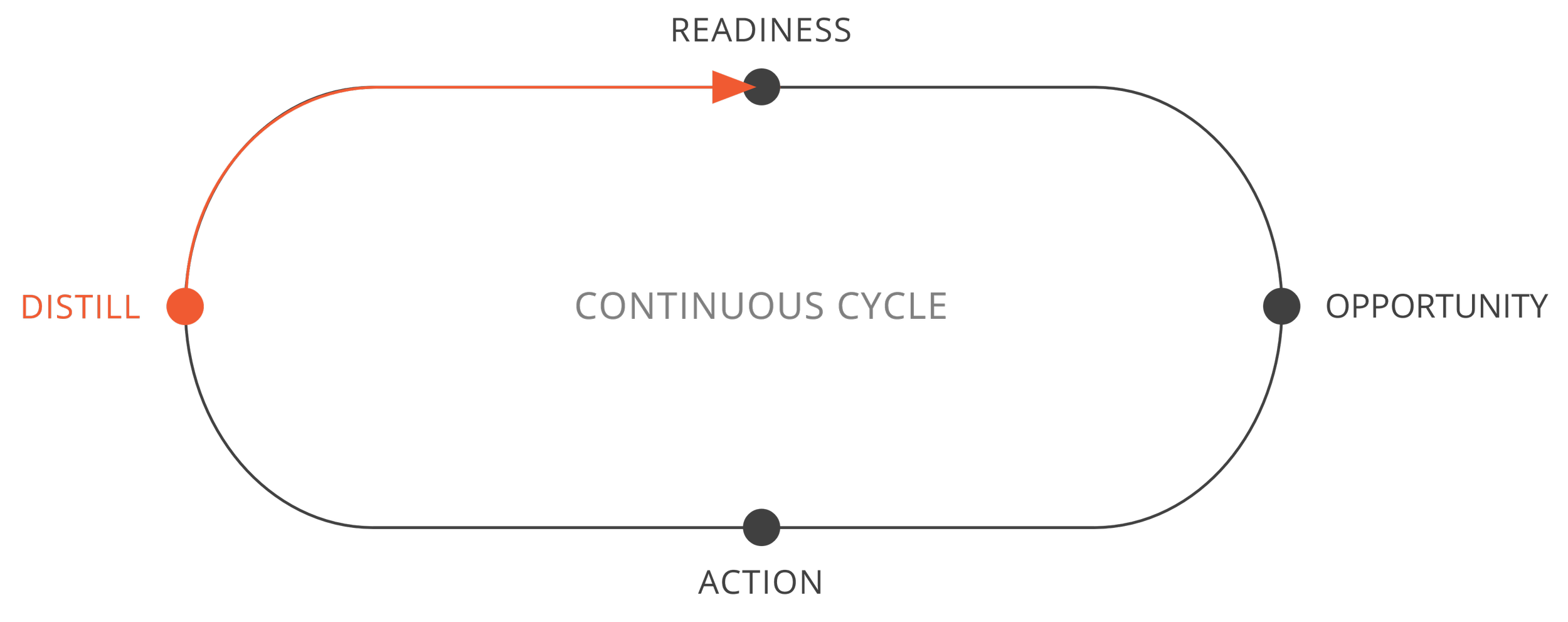
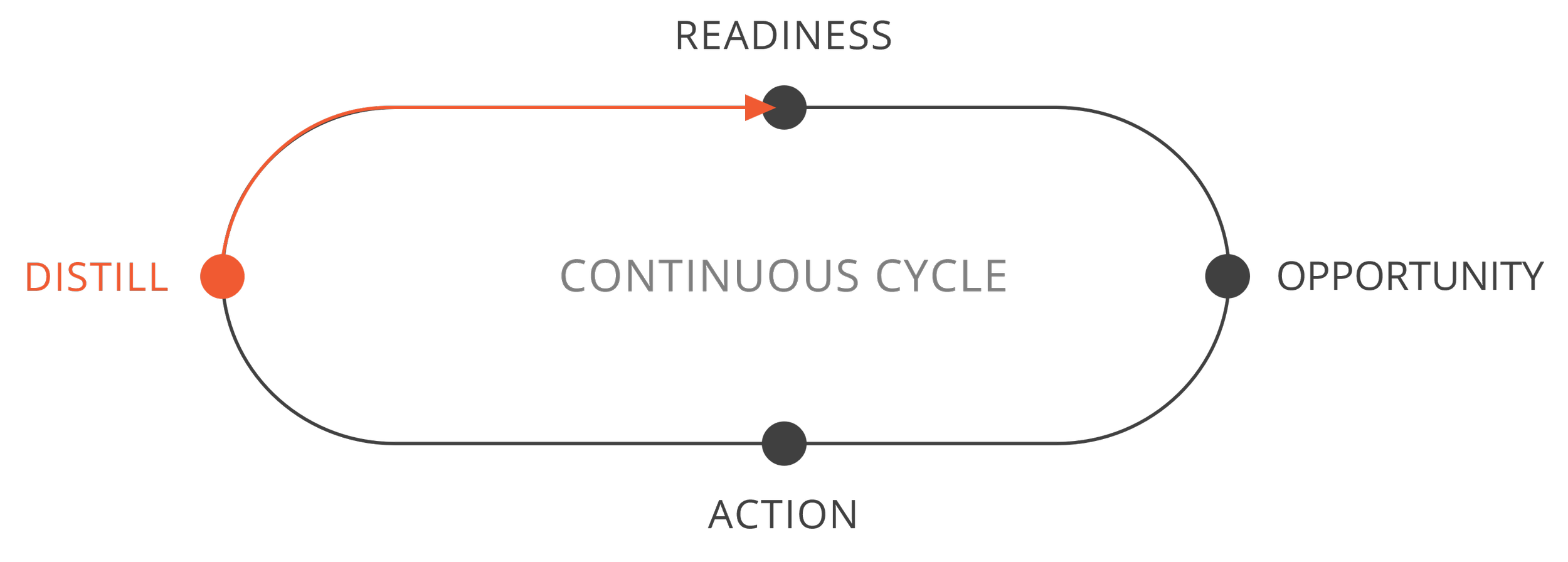
What Distill makes reproducible becomes the baseline for the next cycle: validated success factors raise organizational maturity, and re-assessed readiness decides where, and whether, the next wave starts. New cycles are gated, not scheduled.
Results are an event. Capability is a system.
Find out what
your success is built on.
Thirty minutes. Your situation, our read on it, and whether structured work would change anything.